Frenectomy
Laser tongue tie and lip tie release for babies, children and adults in Canberra.
Frenectomy treatment

Most patients we see are parents of a baby struggling to feed, though ties are also picked up later in childhood or in adulthood, where they affect speech, eating, or oral hygiene. If you suspect a tie, an assessment will tell you whether it’s causing the problem.
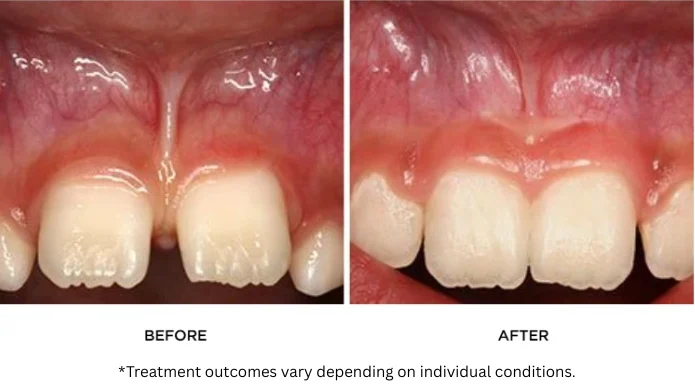
Not every tie needs releasing, and that’s what the assessment determines. A frenectomy releases the band of tissue restricting the tongue or lip. At Dental Sleep & TMJ Therapy Canberra, we use a soft tissue laser to release it, and the treatment itself takes only a few minutes.

What are tongue ties and lip ties?
The frenum is the small band of soft tissue attaching the tongue to the floor of the mouth, and the lip to the gum. When that band is short, tight, or attached in a way that limits movement, it’s called a tongue tie or a lip tie.
A baby’s tongue does most of the work of feeding, so a restriction can make it hard to form a seal and draw milk efficiently. In older children and adults, a tie that was never picked up can affect speech, eating, and how easily the mouth stays clean.
Book a consultation and we’ll assess whether a tie is present and whether it’s causing the problem you’ve noticed.
What are the signs of a tongue tie or lip tie?
Ties are difficult to identify without training, and the signs change with age.

In babies
Difficulty latching or staying latched, feeding that takes a long time or happens very often, clicking sounds during feeds, unsettled or windy behaviour, reflux, and slow weight gain.

In breastfeeding mothers
Mothers often notice it first. Painful feeding, cracked or misshapen nipples, blocked ducts or mastitis, a supply that drops, and the exhaustion that comes with feeds that never seem to finish.

In toddlers and children
Trouble poking the tongue past the lower front teeth or licking the lips, difficulty with sounds like t, d, s, z, th and r, messy eating, a gap between the lower front teeth, and mouth breathing or snoring.

In adults
Limited tongue movement, speech difficulties carried through from childhood, more tooth decay or gum problems because the tongue can't sweep the mouth clean, and tension through the jaw or neck.
Many of these have causes other than a tie, which is why assessment comes before any decision about treatment.

How do we assess whether a frenectomy is needed?
We assess function, not just appearance. A tie that looks tight doesn’t always cause a problem, and releasing one that isn’t restricting anything won’t help.
For a baby, that means watching a feed, checking the range and lift of the tongue, and discussing what’s happening at home. Where a lactation consultant or maternal and child health nurse is already involved, we’ll work with them, because feeding difficulties usually have more than one cause and a release on its own may not resolve them.
For an older child or an adult, we assess tongue movement, speech, oral hygiene and any jaw or neck symptoms before recommending treatment.
Non-surgical support is often worth trying first, and in many cases it’s all that’s needed. If a frenectomy isn’t the answer, we’ll tell you what we think is, whether that’s a referral to a lactation consultant, speech pathologist or your GP.
Why we use a laser light
- The laser seals tissue as it works, so bleeding is usually minimal
- Stitches often aren't needed
- The release takes only a few minutes, which matters most with an unsettled baby
What to expect during a frenectomy
The appointment runs longer than the procedure, because most of it is assessment and aftercare instruction.
Everyone in the room wears protective eyewear. We apply a topical numbing gel, then use the soft tissue laser to release the frenum. The laser seals tissue as it goes, so bleeding is generally minimal and stitches usually aren’t needed.
Babies can feed straight afterwards, and we encourage it. Feeding settles most infants quickly and shows us whether anything has changed.
Dr Kavitha Vegunta will explain the procedure, the aftercare and the costs beforehand, and we’ll go through the risks so you can give informed consent.
What happens after the procedure?
Expect tenderness for a few days. For babies, feeding, cuddles and a clean finger massaging the area all help. For older children and adults, over the counter pain relief is usually enough, and we’ll advise on what’s appropriate.
The frenum can reattach as it heals, so we’ll show you a short set of exercises and how often to do them. For babies, that means gently lifting the tongue and moving it side to side. For older patients, working the tongue to the roof of the mouth (out as far as it goes) and across to each corner.
We’ll book a review to check healing and adjust the exercises if needed.

What are the risks of a frenectomy?
A frenectomy is a minor procedure and complications are uncommon, but it is still surgery, and there are risks you should understand before consenting.
- Bleeding and discomfort at the site for a few days
- Infection
- Scarring
- Reattachment of the frenum as it heals, which the exercises are designed to prevent
- An incomplete release that may need revising
- Temporary feeding refusal or fussiness in infants.
Releasing a tie doesn’t always resolve the difficulty that brought you in, particularly with feeding, where several factors are usually involved. We’ll be upfront about what a frenectomy can and can’t change in your situation.
Book an assessment
If you’re concerned about a possible tongue tie or lip tie, book an assessment. We’ll examine tongue movement and function, and recommend a frenectomy only if the restriction warrants it.